A few weeks ago I shared that I was going to be interviewed by WEAR News Channel 3 here in Pensacola. What I didn’t fully anticipate was how it would feel to sit down and
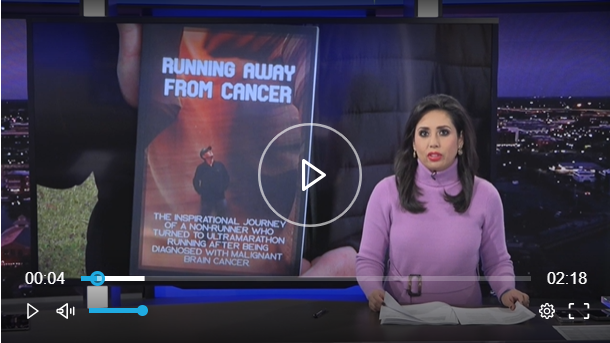
A few weeks ago I shared that I was going to be interviewed by WEAR News Channel 3 here in Pensacola. What I didn’t fully anticipate was how it would feel to sit down and tell that story out loud — the diagnosis, the surgery, the speech therapy, the running, the book — all of it compressed into a few minutes of television.
The segment aired on the 5pm and 10pm shows, with the full version running at 10pm. If you missed it, I’m going to share the highlights here — because this story deserves more than a 90-second TV spot.
How It Started: A Brain Tumor Nobody Expected
In 2010, I went in for what I thought was a routine sinus surgery. A CT scan done during pre-op revealed something that had nothing to do with my sinuses: a golf ball-sized tumor growing in my brain.
The diagnosis was oligodendroglioma — a type of brain tumor. I was shocked. I had no idea anything was wrong beyond what I thought were chronic sinus and headache issues.
What made it hit even harder: my daughter was only a month old when I got the news.
“I was always worried that she’d never know who her dad was — and my sons too,” I told the WEAR reporter. That fear — of not being there, of being taken before my kids really knew me — that’s the kind of thought that grabs you by the throat and doesn’t let go.
The Surgery, the Recovery, and Learning to Speak Again
The tumor was removed. But recovery from brain cancer surgery is not a straight line.
Mine included speech therapy, radiation, and chemotherapy. The speech therapy part is something I don’t talk about enough. The treatments affected my word retrieval — I knew what I wanted to say, but the right words wouldn’t come out.
“They’d show you little cards — like a picture of a dog — and I was supposed to say what it was,” I explained during the interview. “But I would say it was a tree or something. I knew what it was. I just couldn’t pull out the right words.”
That was humbling in a way that’s hard to describe. I felt drained. I stayed inside. For a while, the world got very small.
Running Changed Everything
About two years after my diagnosis, something shifted. My sons joined a running club — and I started walking alongside them.
That walk turned into a run. That run turned into a longer run. And somewhere in those miles, I found something I hadn’t felt in a long time: myself.
“It just made me feel more alive and more healthy,” I told WEAR. “My concerns about the cancer treatment and what’s going to happen with my life — it all just kind of faded away.”
I ran my first marathon in 2014. By the time of this interview I had completed 97 marathons. I’ve since passed that milestone many times over — including ultramarathons and 100-milers. Running didn’t just give me a hobby. It gave me a reason to push, to compete, to show up, and to believe that my story wasn’t finished.
The Book: A Journal for My Family and a Light for Others
For years I kept a written log of my races and my recovery. Those notes became the foundation for “Running Away From Cancer” — my memoir about the diagnosis, the treatment, the running, and the life I’ve built on the other side of all of it.
I wrote it for a lot of reasons. But when the WEAR reporter asked me why, the answer that came out was the most honest one I have:
“For my family, my kids — it’s a journal that can always be there for them, no matter what happens.”
That’s the heart of it. Whatever happens tomorrow, my kids will always be able to open that book and know who their dad was, what he went through, and how hard he fought to still be here.
If it also helps someone else who just got a brain cancer diagnosis feel a little less alone — that’s everything.
Thank You, Pensacola
I want to say thank you to everyone who reached out after the segment aired. The messages, the support, the people who said they shared it with someone going through something similar — that’s exactly why I do this.
To the team at WEAR News Channel 3 — thank you for telling this story and for giving brain cancer survivorship a few minutes of airtime in our community.
And to anyone reading this who is in the middle of their own hard season: keep moving. Whatever your version of running looks like — keep moving forward.