When you’re handed a brain tumor diagnosis, everything moves fast — and nothing feels certain. One moment you’re preparing for a routine sinus surgery, and the next you’re sitting in a chair being told a
When you’re handed a brain tumor diagnosis, everything moves fast — and nothing feels certain. One moment you’re preparing for a routine sinus surgery, and the next you’re sitting in a chair being told a radiologist found something that doesn’t belong in your head. The next question becomes one of the most important decisions of your life: where do you go, and who do you trust to operate on your brain?
This is my story of finding the right brain cancer hospital — and why getting a second (and third) opinion may have been the best decision I ever made.
The Diagnosis: From Pre-Op Scan to Brain MRI
After my brain tumor was discovered on a pre-operative scan, my ENT immediately referred me for a brain MRI. The results confirmed it: I had a tumor that required the attention of a neurosurgeon. Suddenly I wasn’t researching sinus recovery times — I was researching brain cancer treatment centers and neurosurgical specialists.
If you’ve never had to find a neurosurgeon before, you quickly realize there’s no simple roadmap. Most people don’t know where to start. I didn’t either.
Two Referrals, Two Different Paths
Almost immediately, two people in my life pointed me in different directions — and both recommendations came from personal experience, which made them impossible to ignore.
The first referral came through my cousin. She had suffered a brain hemorrhage and the neurosurgeon who treated her had saved her life. That kind of recommendation carries weight. I made an appointment with that local brain surgeon and went in expecting answers.
What I got instead was another referral — and it turned out to be exactly the right one.
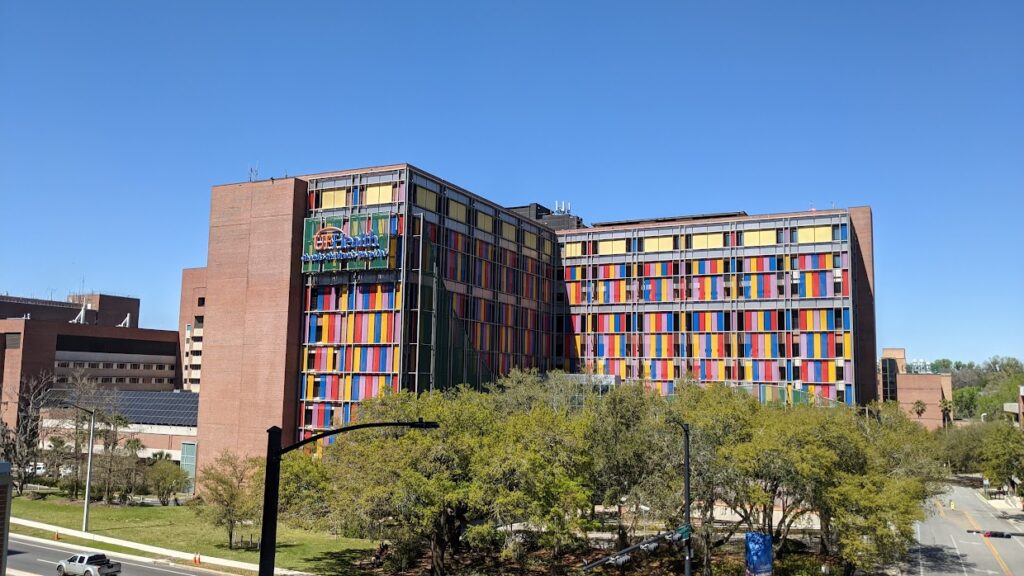
Her neurosurgeon examined my case and immediately referred me to Dr. Roper at Shands Hospital (UF Health) in Gainesville, Florida. Dr. Roper was not just any neurosurgeon. He was a specialist in the specific location of my brain tumor — and he was also a professor at the University of Florida College of Medicine. That combination of clinical expertise and academic standing told me he was operating at the highest level of his field.
The second referral pointed me toward a neurosurgeon in Birmingham, Alabama. I wasn’t going to ignore it. When you have a brain tumor, you don’t dismiss any credible lead.
UF Health Shands Hospital — A Place I Already Trusted
Here’s something that made this decision feel personal from the start: I used to live in Gainesville. I already knew UF Health Shands Hospital. I already knew the city, the campus, the culture around that medical center. In the back of my mind, I already knew where I wanted to go.
But I wasn’t going to let familiarity make the decision for me. I needed to do this right.
Why I Saw 3 Doctors Before Deciding
Before committing to any hospital or treatment plan, I did something I’d never done before in my medical life — I got multiple opinions from multiple neurosurgeons.
I had always assumed that doctors, especially specialists, would generally arrive at the same conclusion. A tumor is a tumor. A treatment plan is a treatment plan. I was wrong.
The Birmingham neurosurgeon recommended a “wait and monitor” approach — watching the tumor over time to see how it behaved before taking any action. For some patients in some situations, that may be a reasonable strategy.
For me, it didn’t feel right. I wasn’t comfortable sitting with an unaddressed brain tumor and hoping for the best. I needed action. I needed a specialist who felt the same urgency I did.
Dr. Roper at UF Health Shands had a clear plan. His expertise in my tumor’s specific location, combined with the resources of a major academic medical center, gave me confidence that I was in the right hands.
I chose Shands. And I’ve never looked back.
What I Found at UF Health Shands Hospital in Gainesville
Walking into UF Health Shands Hospital, a few things stood out immediately — and they mattered more than I expected.
- The hospital was clean and well-organized. That sounds basic, but when you’re about to have brain surgery, the environment tells you something about how an institution operates.
- The staff was always ready to help. From the front desk to the surgical team, every person I encountered was attentive, professional, and genuinely focused on patient care.
- I felt safe there. That’s the most honest way I can put it. When you’re facing brain cancer surgery, feeling safe in your hospital is not a small thing — it’s everything.
UF Health Shands is consistently ranked among the top hospitals in Florida and is nationally recognized for neurology and neurosurgery. For a complex brain tumor case, that level of institutional expertise matters enormously.
The Lesson: Get Multiple Opinions Before You Decide
Before this experience, I would have assumed that one expert neurosurgeon would give me the same answer as any other. I know better now.
Different doctors bring different philosophies, different specializations, and different risk tolerances. The “wait and monitor” approach from Birmingham wasn’t necessarily wrong — it just wasn’t right for me. Had I accepted the first opinion I received, my journey could have looked very different.
If you or someone you love is facing a brain tumor diagnosis, here is what I would tell you:
- See at least 2–3 neurosurgeons before committing to a treatment plan. The extra appointments are worth the time.
- Look for a specialist in your specific tumor type and location. General neurosurgeons are skilled, but subspecialty expertise matters for complex cases.
- Consider academic medical centers and teaching hospitals. Institutions like UF Health Shands attract specialists who are also researchers — people working at the cutting edge of treatment.
- Trust your gut when something doesn’t feel right. A treatment plan that doesn’t sit right with you is worth questioning, even if the doctor recommending it is qualified.
- Ask about each doctor’s experience with your specific diagnosis. How many cases like yours have they treated? What are their outcomes?
You Are Your Own Best Advocate
A brain cancer diagnosis is terrifying. But you are not powerless. The doctors you choose, the hospitals you select, and the treatment plans you agree to are decisions that belong to you.
I didn’t just take the first answer I was given. I asked questions. I sought out a specialist. I traveled to a hospital I trusted. And I pushed until I found a path that felt right.
That decision — to keep asking, keep looking, and keep advocating for myself — is one I’m grateful for every single day I lace up my running shoes.